Editor: V. Dimov, M.D., Allergist/Immunologist, Cleveland Clinic Florida, Clinical Associate Professor, FAU Charles E. Schmidt College of Medicine
Reviewer: S. Randhawa, M.D.
Questions to ask if a patient has a suspected episode of anaphylaxis
1. Any food or drugs taken within 6 hours before the event? (within 2 hours for food allergy). Was the food raw, semi-cooked, cooked, or baked? Quantity of allergen ingested (how much of the food)?
2. Activity in which the patient was engaged at the time of the event?
3. Location of the event? (home, school, work, indoors, or outdoors)
4. Exposure to heat or cold?
5. Any related sting or bite?
6. Time of day or night?
7. Duration of the event? How long did it last?
8. Recurrence of symptoms after initial resolution?
9. Exact nature of the symptoms (eg, if skin symptoms, determine whether flush,
pruritus (itching), urticaria (hives), angioedema). Ask about urticaria, angioedema, erythema, pruritus, vomiting, abdominal pain, persistent cough, hoarse voice, wheeze, stridor, respiratory distress, or nasal congestion. Cardiovascular symptoms such as hypotension, extreme lethargy, or syncope.
10. Physical factors or triggers? Exercise or ingestion of aspirin or alcohol?
11. In a female, any relationship between the event and menstrual cycle?
12. Was medical care given and what treatments were administered? Epinephrine? Was EpiPen or Auvi-Q prescribed?
Possible causes of anaphylaxis
Common
- Foods: most commonly peanuts, tree nuts, egg, fish, shellfish, cow’s milk, and wheat
- Medications: most commonly antibiotics or NSAIDs
- Allergen immunotherapy
- Insect stings (bees and wasps)
- Unidentified (no cause found; idiopathic anaphylaxis)
Less common
- Exercise, WDEIA - omega-5 gliadin sIgE
- Natural rubber latex
- Semen
- Hormonal changes: menstrual factors
- Topical medications (e.g., chlorhexidine, polysporin)
- Transfusions
- Alpha-gal
References:
Treatment of patients who present after an episode of anaphylaxis. Lieberman P. Ann Allergy Asthma Immunol. 2013 Sep;111(3):170-5. doi: 10.1016/j.anai.2013.06.018.
http://www.ncbi.nlm.nih.gov/pubmed/23987190
Anaphylaxis. Practical guide for allergy and immunology in Canada 2018 https://buff.ly/2MydS0V
Updated: 12-11-2018
Showing posts with label Anaphylaxis. Show all posts
Showing posts with label Anaphylaxis. Show all posts

How To Use Epinephrine Autoinjector - EpiPen
Editor: V. Dimov, M.D., Allergist/Immunologist, Cleveland Clinic, Florida
How to use EpiPen. Epinephrine auto-injector (EAI) in the form of a device (EpiPen) was first introduced in 1980.
How To Use an EpiPen video from Nationwide Children's Hospital in Columbus, Ohio:
The action plans for food allergy and anaphylaxis include the use of epineprine as first line of treatment.
Key points:
- There is no cure for food allergies at this time
- 8% of U.S. children under 18 have at least one food allergy
- Epinephrine is the first line life-saving medication in severe food allergic reaction. Always carry an EpiPen with you, and remember these simple memory rules in severe food allergic reaction:
- "No Epi, no eat-y" (always carry an EpiPen with you, don't sit down to eat if you don't have an EpiPen available)
- "If it's more than the skin, the Epi goes in" (only mild hives may respond to antihistamine, for anything else you may need an EpiPen)
"How to C.A.R.E. for students with food allergies" is a free online course available at AllergyReady.com
Tips for managing food allergy (MJA, 2004):
- Always carry an epineprine auto-injector (EAI)
- Always read food labels
- Ask questions about food preparation (be aware of the risk of cross-contamination)
- No label/don't eat
- No Epi/don't eat
- Tell friends about a serious food allergy
- Tell friends if feeling unwell, especially after eating
Eleanor Garrow, Vice President of Education and Outreach for FAAN, talks about living with food allergies, 2010.
FAANPAL | 2010 | A presentation of food allergy basics by Eleanor Garrow, Vice President of Education and Outreach for FAAN.
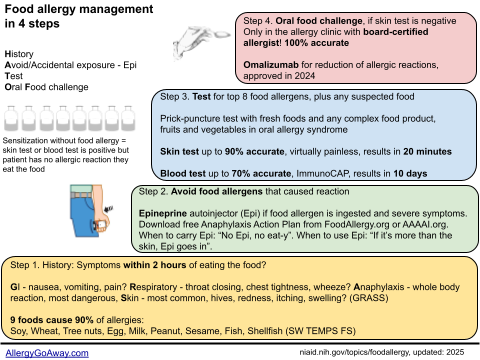
Food allergy management (click to enlarge the image).
Related information
Food Allergy Information from ACAAI
Free pamphlets (brochures) from National Institutes of Health - Publications Order Form.
Food allergy and anaphylaxis training - free at AllergyReady.com
Managing Food Allergy - COFAR video, 2012.
Food Allergy: An Overview for Patients (PDF)
Guidelines for the Diagnosis and Management of Food Allergy in the United States: Executive Summary of the NIAID-Sponsored Expert Panel Report (PDF)
Videos from the KFA channel on YouTube -"Kids With Food Allergies"
Cetirizine is better than diphenhydramine (Benadryl) in the treatment of acute food-induced allergic reactions. JACI, 2011.
"Epinephrine is to anaphylaxis as an AED (defibrillator) is to someone suffering cardiac arrest. Life-saving." Forbes, 2012.
Published: 01/29/2011
Updated: 01/12/2017
How to use EpiPen. Epinephrine auto-injector (EAI) in the form of a device (EpiPen) was first introduced in 1980.
How To Use an EpiPen video from Nationwide Children's Hospital in Columbus, Ohio:
The action plans for food allergy and anaphylaxis include the use of epineprine as first line of treatment.
Key points:
- There is no cure for food allergies at this time
- 8% of U.S. children under 18 have at least one food allergy
- Epinephrine is the first line life-saving medication in severe food allergic reaction. Always carry an EpiPen with you, and remember these simple memory rules in severe food allergic reaction:
- "No Epi, no eat-y" (always carry an EpiPen with you, don't sit down to eat if you don't have an EpiPen available)
- "If it's more than the skin, the Epi goes in" (only mild hives may respond to antihistamine, for anything else you may need an EpiPen)
"How to C.A.R.E. for students with food allergies" is a free online course available at AllergyReady.com
Tips for managing food allergy (MJA, 2004):
- Always carry an epineprine auto-injector (EAI)
- Always read food labels
- Ask questions about food preparation (be aware of the risk of cross-contamination)
- No label/don't eat
- No Epi/don't eat
- Tell friends about a serious food allergy
- Tell friends if feeling unwell, especially after eating
Eleanor Garrow, Vice President of Education and Outreach for FAAN, talks about living with food allergies, 2010.
FAANPAL | 2010 | A presentation of food allergy basics by Eleanor Garrow, Vice President of Education and Outreach for FAAN.
Food allergy management (click to enlarge the image).
Related information
Food Allergy Information from ACAAI
Free pamphlets (brochures) from National Institutes of Health - Publications Order Form.
Food allergy and anaphylaxis training - free at AllergyReady.com
Managing Food Allergy - COFAR video, 2012.
Food Allergy: An Overview for Patients (PDF)
Guidelines for the Diagnosis and Management of Food Allergy in the United States: Executive Summary of the NIAID-Sponsored Expert Panel Report (PDF)
Videos from the KFA channel on YouTube -"Kids With Food Allergies"
Cetirizine is better than diphenhydramine (Benadryl) in the treatment of acute food-induced allergic reactions. JACI, 2011.
"Epinephrine is to anaphylaxis as an AED (defibrillator) is to someone suffering cardiac arrest. Life-saving." Forbes, 2012.
Published: 01/29/2011
Updated: 01/12/2017
Subscribe to:
Posts (Atom)